An entryway has a busy job. It welcomes guests, catches the shoes and bags that come through the door, and gives you somewhere to pause before heading out again. When those everyday needs have been considered, even a modest entrance can feel inviting and thoughtfully decorated.
This navy entryway brings the idea together beautifully: deep blue cabinetry, a cream seat cushion, warm metal details, woven baskets, a patterned runner, and a touch of greenery. The contrast gives the space character, while the practical storage keeps the floor useful.
Welcome to The Decor Hours. In this guide, we will break that look into 12 approachable ideas, starting with three storage decisions and finishing with the details that make an entrance feel like part of your home. You will learn what each element adds, where to place it, and how to adapt the idea if your entryway is smaller or you cannot install built-in furniture.
You do not need to buy everything at once. A clear place for shoes, a well-positioned mirror, and one or two coordinated accessories can be a strong beginning.
1. Start with a shoe-storage bench.
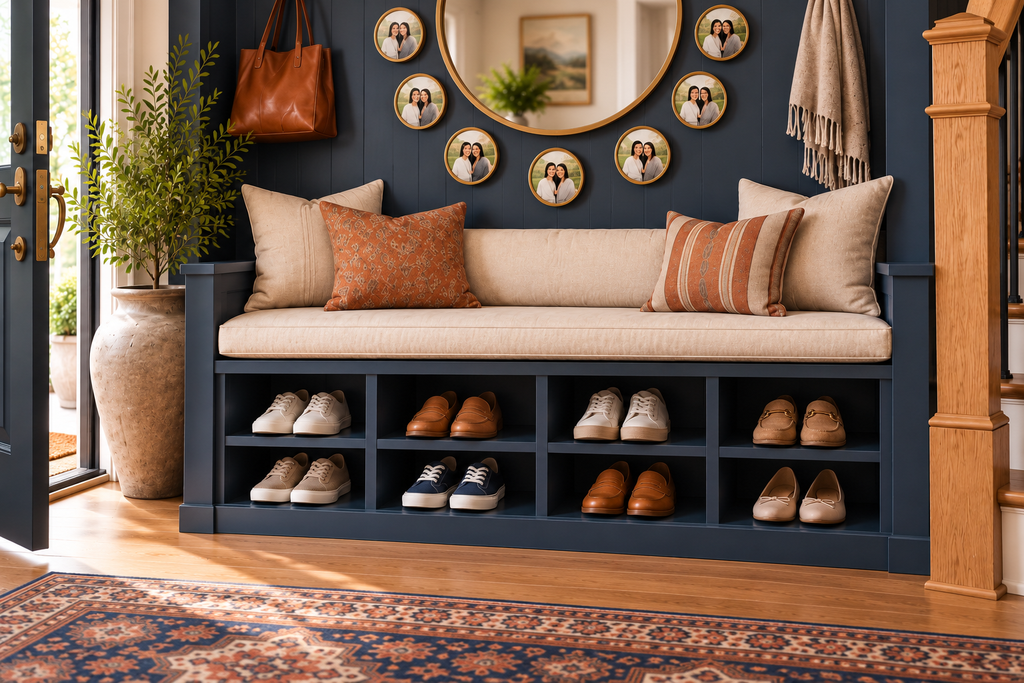
Freestanding navy bench with shoe cubbies and a cream cushion beside a clear entryway walkway.
A shoe-storage bench gives the entrance two useful functions in one footprint: somewhere to sit while putting on shoes and somewhere to keep those shoes off the floor. In the reference look, the navy cubbies feel like part of the wall, which makes the storage appear calm and intentional.
Choose the arrangement around your household’s shoes. Low cubbies can suit sneakers and flats, but tall boots need more clearance. Keep the most frequently worn pairs easiest to reach and find another home for shoes that are rarely used. Open compartments can look attractive when they are not packed beyond capacity; closed storage may suit you better if you prefer less visible detail.
If custom cabinetry is outside the budget, a freestanding storage bench can provide the same practical starting point. Look for a piece intended for sitting, check its stated load rating, and measure it against the door swing and walkway. A storage cabinet is not automatically suitable as seating.
SMALL – ENTRYWAY VERSION : Use a compact bench with only the shoe spaces you need each day. A shorter piece that leaves room to move is more useful than a wall-to-wall unit that crowds the entrance.
2. Use upper shelves and woven baskets.
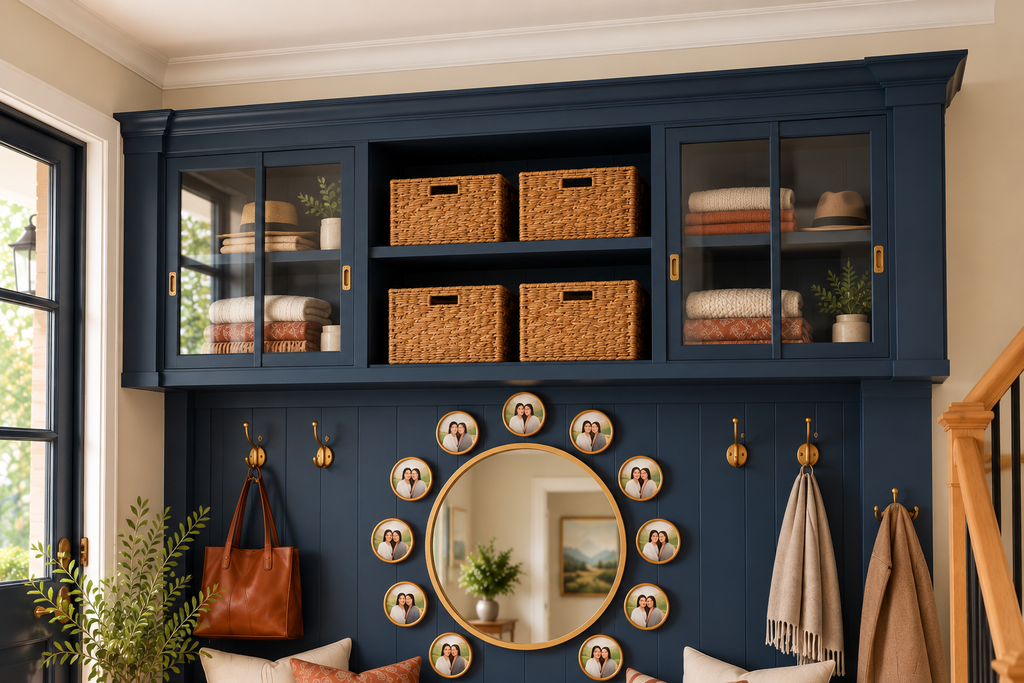
Woven baskets in navy upper cubbies above a cream-cushioned entryway bench.
Upper shelves make use of wall space without taking more floor area. Woven baskets soften the navy finish and conceal the small, irregular items that otherwise make open shelving look busy. Their texture also connects naturally with a warm floor, a plant pot, or a neutral seat cushion.
Measure each shelf opening before choosing baskets, including the space needed to lift or slide them out. A basket may fit inside a cubby but still be awkward to use if its handle touches the shelf above. Similar shapes and finishes create an orderly look even when the contents are different.
Keep lightweight, less frequently used items overhead, such as seasonal scarves or spare hats. Daily essentials belong where they are easy to reach. Give each basket a clear purpose so that it does not become another place for miscellaneous clutter.
LOWER – COST VERSION : If you already have open shelving, start by coordinating the containers rather than replacing the furniture. Check shelf mounting and load guidance, and avoid placing heavy items where retrieving them would be difficult.
3. Give coats, bags, and keys their own place.
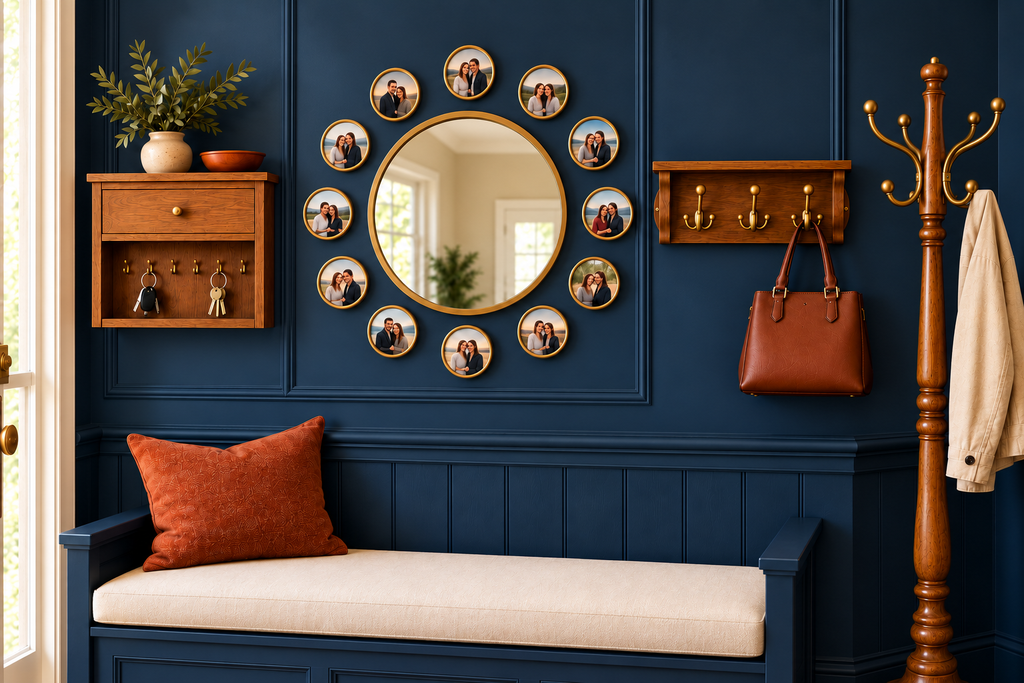
Spaced coat hooks and a separate small key rack organizing belongings beside an entryway bench.
Wall hooks turn an empty area into a practical arrival spot. In a navy entrance, warm metal hooks can also become a decorative detail, especially when their finish relates to the mirror or ceiling light. The arrangement should work with what you hang there, not only look balanced when empty.
Leave enough room between hooks for jackets and bags to hang without becoming one bulky pile. Position them so hanging items do not cover the mirror or spill onto the main sitting area. Use suitable wall fixings and follow the hook manufacturer’s load limits; a small decorative hook is not necessarily designed for a heavy handbag.
Add a separate, easy-to-reach place for keys if they regularly go missing. A compact key rack can work beside the door, while a shallow tray may suit an existing ledge. You do not need to add a console table solely for keys when floor space is limited.
EVERYDAY HABIT : Keep only current coats and regularly used bags here. Moving occasional items elsewhere makes the hook area easier to use and allows the decorative details to remain visible.
4. Make a round mirror the focal point.
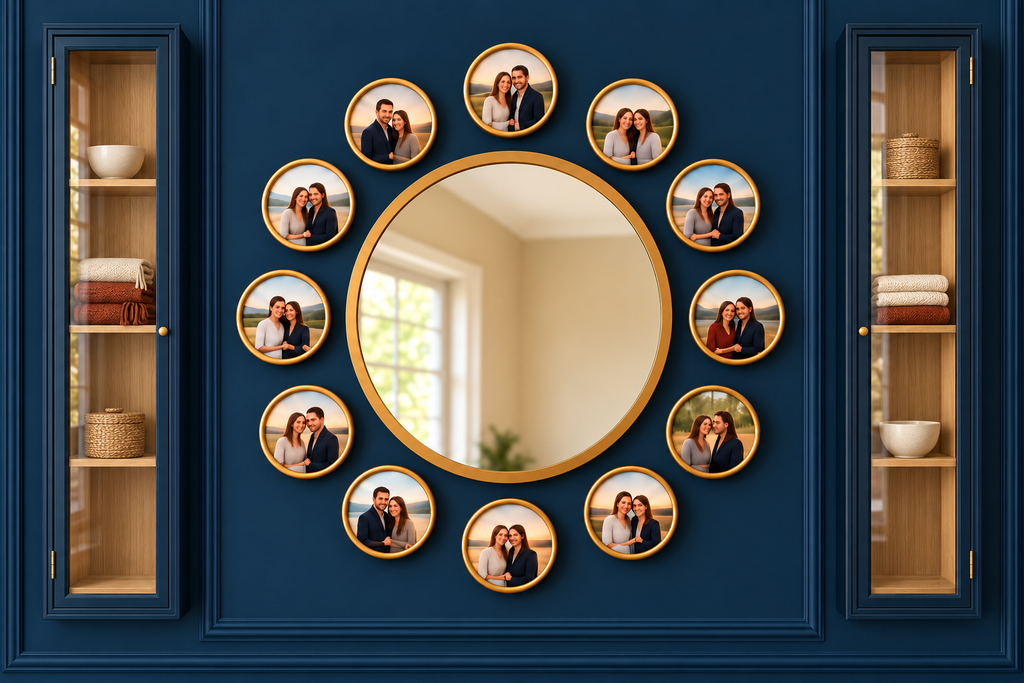
Round brass-framed mirror above a navy bench with a cream cushion and rust accent pillow.
A round mirror introduces a soft shape among the straight lines of a bench, shelving, door, and wall paneling. Against navy, a slim warm-metal frame gives the wall a clear focal point without needing several extra decorations. It is useful for a final look before leaving and can reflect an attractive part of the entrance.
Choose the mirror in relation to the bench and the available wall area. Make a paper template first so you can judge its width and position before purchasing or drilling. Check the reflection from the doorway: reflecting daylight or a calm wall is usually more appealing than reflecting an overflowing coat rack.
If hooks share the same wall, plan the mirror and hanging items together. The mirror needs visible space around it, and bags should not knock against its edge. Follow mounting instructions appropriate to its weight and your wall.
SMALL – ENTRYWAY VERSION : A modest mirror with a slim frame can give the wall a focal point without projecting far into the walkway. It does not have to be oversized to make a useful contribution.
5. Soften the bench with cream cushions and a personal accent.
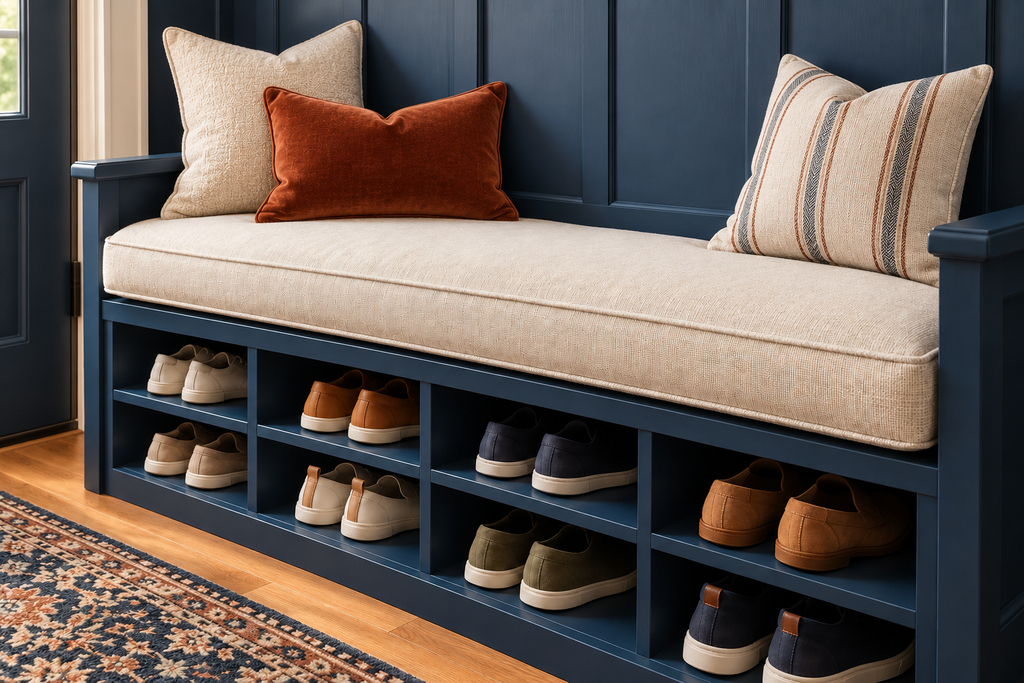
Cream seat cushion and a small accent pillow softening a navy entryway bench. Update the pillow description to match the generated image.
A cream seat cushion balances the depth of navy cabinetry and makes the bench more welcoming to use. Choose the cushion for the bench’s actual seat dimensions, including any shaped corners, rather than estimating from a photograph. Consider whether a removable cover and the recommended cleaning method suit a busy entrance.
Decorative pillows are a separate finishing layer. One neutral cushion and one rust-toned or subtly patterned accent can connect the seat to the runner without taking over the bench. Leave enough room for someone to sit comfortably; a bench that must be emptied before every use is overstyled.
A personalized pillow is another option if you want a meaningful detail. A favorite photograph with a simple composition can work well alongside plain textiles. Keep the design restrained if the rug or wall already provides plenty of visual interest.
WHERE TO SHOP : Explore Giftlab’s personalized pillow collection for an optional accent. Check the selected listing’s size, fabric, customization preview, and whether the insert is included. This is a decorative pillow recommendation, not a source for the fitted seat cushion. [Explore personalized accent pillows — INSERT GIFTLAB PILLOW AWIN LINK]
6. Bring the entryway to life with greenery
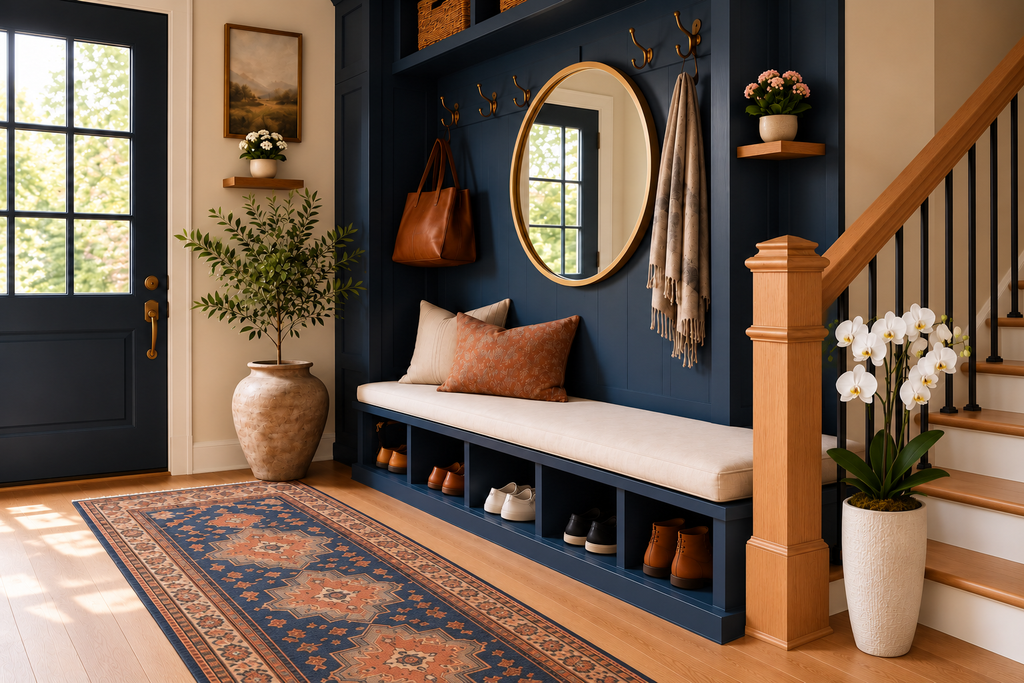
Leafy houseplant positioned near entryway daylight beside a navy storage bench. Add the species only after confirming it.
Greenery introduces a shape and texture that cabinetry cannot provide. A leafy plant beside the entrance can soften the transition between the dark feature wall and pale surrounding walls. It also gives an otherwise quiet corner a purpose without filling it with several small ornaments.
Choose the plant for the actual light available in that corner. A bright-looking image is not proof that a particular species will thrive in your home. Observe the window light, read the plant’s care requirements, and account for the changes caused by closed curtains or a door that stays shut for much of the day.
Allow space for the leaves as well as the pot. The plant should not obstruct a door, brush everyone who passes, or sit where it is frequently knocked. Check species-specific suitability if pets or young children can reach it. A smaller plant on an existing stable surface can be more practical than a floor plant in a narrow hall.
WHERE TO SHOP : Plant Addicts offers houseplants to compare with your available light and care routine. Check the size supplied rather than assuming you will receive the mature plant shown in a lifestyle illustration. [Explore houseplants for your entryway — INSERT PLANT ADDICTS HOUSEPLANT AWIN LINK]
7. Choose a planter that belongs in the decorating scheme
The planter contributes almost as much to the room’s appearance as the greenery. A warm neutral pot can stand out gently against navy, while a simple shape keeps the entrance from feeling crowded. Texture can connect it to baskets and wood without requiring an exact material match.
Start with the plant’s needs and nursery-pot size, then choose an outer pot or planter that fits the intended setup. A large decorative vessel is not automatically a reason to move a small plant into much more soil. If using a nursery pot inside a decorative cover, make sure it can be removed when needed and that the drainage arrangement is appropriate.
Protect the floor from collected water and check whether the planter is intended for indoor use. A product that looks like stone or ceramic may be made from another material, so rely on its description for weight, care, and construction.
WHERE TO SHOP : Browse Plant Addicts’ modern planters for a suitable shape and size. The range includes different styles and scales; choose an indoor-appropriate option that leaves the walking route clear. [Browse decorative planters — INSERT PLANT ADDICTS PLANTER AWIN LINK]
8. Connect the colors with a patterned runner
A runner helps connect the individual parts of the entrance. A restrained navy, rust, and cream pattern can repeat the cabinetry, pillow, and seat colors, making the scheme feel deliberate. Pattern also gives the floor visual interest without requiring another object on a shelf or wall.
Measure the usable floor area and mark the proposed rug outline before ordering. Leave a visible border of flooring where the layout allows, and make sure the door opens freely over the rug and any pad. Check the route into adjoining rooms and the position of nearby steps so that edges do not create an awkward transition.
Think about the traffic this entrance receives. Read the fiber content, care instructions, pile height, and backing details. Use a suitable nonslip solution compatible with the flooring and rug, following the maker’s guidance. A patterned rug is decorative, but it still needs a cleaning routine that fits daily use.
LOWER – COST VERSION : If your existing runner already contains one or two colors from the room, use those shades in a pillow or artwork. Repeating what you own may be enough to connect the scheme.
9. Create depth with navy paint or paneling.
Navy gives this entrance its strongest visual identity. It allows cream textiles, woven baskets, and warm metal details to stand out, while pale adjacent walls keep the whole space from becoming uniformly dark. You can create the effect on cabinetry, a paneled wall, or a smaller painted feature.
Test actual paint samples in your entrance before committing. Look at them in daylight and with the evening lights on, alongside the floor and the textiles you intend to keep. A color that looks blue on a screen may feel grayer, greener, or almost black in a different room.
If using paneling, plan how it meets the skirting, corners, sockets, and furniture. Simple, proportionate detailing often works better in a compact space than several competing patterns. Choose preparation and finishes appropriate to the surface, especially for furniture that receives frequent contact.
RENTER – TRIENDLY DIRECTION : Introduce navy through a freestanding piece, a runner, and cushions if painting is not permitted. The color in the inspiration image is a visual reference, not a verified paint-brand match.
10. Finish with lighting that suits the entrance.
Lighting should make the entrance easy to use as well as attractive. A decorative ceiling fixture can bring attention upward and connect to the mirror or hooks, but its shape and drop need to suit the actual ceiling height, door movement, and walking route.
A pendant or lantern-style fixture may suit an entrance with sufficient clearance. For a lower ceiling, a flush mount can provide a finished look without a long drop. Consider how the shade distributes light: a striking silhouette may still leave a mirror or shoe area too dim if it is the only light source.
Keep the finish related to the room rather than trying to match every piece exactly. Warm metal, a restrained dark finish, or a subtle woven texture can each work with navy, depending on the rest of the scheme. Confirm electrical requirements, bulb specifications, and dimmer compatibility where relevant, and arrange appropriate professional installation.
WHERE TO SHOP : Rowabi has pendant and flush-mount collections to explore. Select for the entrance’s dimensions and lighting needs; these are alternatives for the look, not a claim that Rowabi made the exact lantern in the reference image. [Explore entryway ceiling lighting — INSERT ROWABI AWIN LINK]
11. Add artwork and repeat warm metal details.
A small piece of artwork can make an entryway feel connected to the rest of the home. A landscape with muted greens, browns, or cream can work beside the plant and runner, while a favorite personal photograph offers a different kind of connection. Choose something you enjoy rather than adding art simply to cover a blank wall.
Pay attention to scale and the surrounding features. A narrow wall beside the door may need a smaller frame, while the main navy wall may already feel complete with its mirror and hooks. Use paper templates to test placement, and make sure the door or hanging bags will not strike the frame.
Repeat a warm metal finish in a few places to connect the arrangement. The mirror, hooks, and light can share a similar warmth without being an identical set. If there is already enough brass in the space, a simple wood frame can provide balance.
LOWER – COST VERSION : Reframe art or photographs you own. One carefully placed piece is often enough to give an entrance personality while leaving the practical areas clear.
12. Complete the welcome with a personalized doormat.
A doormat introduces the home before anyone reaches the bench or mirror. A restrained name design or simple welcome message can feel personal while working with the indoor palette. Keep the design easy to read and choose colors that sit comfortably beside the door and flooring.
A doormat and an interior runner have different jobs. The mat serves the immediate arrival point; the runner connects the hallway visually. If the two sit near each other, allow them distinct positions rather than overlapping edges in the walking route.
Check where the specific mat is intended to be used. Some decorative products suit a sheltered or indoor position rather than an exposed doorstep. Read the material, backing, thickness, cleaning guidance, and any outdoor-use information before choosing. Do not assume that every personalized mat is weatherproof or designed to scrape heavy mud from shoes.
WHERE TO SHOP : Giftlab’s custom-doormat collection includes personalized options. Choose a design that suits everyday use, then verify its dimensions and intended placement. [Explore personalized welcome mats — INSERT GIFTLAB DOORMAT AWIN LINK]
Recreate this entryway in five steps
- Solve the everyday clutter first. Decide where daily shoes, bags, coats, and keys belong. Choose a bench and hooks that fit the space.
- Set the color direction. Use navy as the anchor with cream and warm wood. Add rust or another accent only where it helps connect existing pieces.
- Place the mirror and lighting. Check proportions, reflections, door clearance, and how the entrance works after dark.
- Soften the hard surfaces. Add a correctly fitted seat cushion, a restrained pillow arrangement, and a suitable runner.
- Finish with greenery and personal details. Choose a plant for the light, a practical planter, and a small amount of art or personalization. Stop before useful surfaces become crowded.
What if your entryway is very small?
Borrow the palette and functions rather than trying to fit the entire reference arrangement into your home. A short shoe bench, a wall mirror, and a few hooks can create the foundation. Keep the plant smaller, skip extra furniture, and use existing wall space thoughtfully.
You can also create the look without a built-in. A freestanding navy bench against a pale wall, a warm-metal mirror, and a coordinated runner can establish the same visual direction. Let the size and routine of your household determine how much you add.
Common questions
Do I need custom cabinets for this look?
No. Built-ins can make use of an exact wall width, but a freestanding storage bench and a well-planned hook area can serve many of the same everyday needs. Check each piece’s dimensions and intended use rather than trying to copy the photograph exactly.
Will navy make the entrance feel too dark?
It depends on the available light and how much of the room you paint. Start with samples and consider keeping adjacent walls and larger textiles light. You can also introduce navy through furniture and accessories while leaving the walls unchanged.
Should I use both a runner and a doormat?
Only if the layout gives each one a useful place. A compact entrance may need just a suitable mat. In a longer hallway, a separate runner can add comfort and connect the colors farther into the house. Keep edges secure and the door operating freely.
Can I use the same plant shown in the illustration?
Choose a plant by its verified identity and care requirements, not appearance alone. AI styling images can suggest placement and scale, but the product page and your actual growing conditions should guide the purchase.
A welcoming entrance starts with useful choices
The appeal of this navy entryway comes from the way practical storage and decoration work together. Shoes have a place, the bench is comfortable to use, and the mirror, textiles, plant, and lighting bring warmth to the arrangement.
Begin with the change that would make daily life easier. That might be clearing the shoe pile, fitting a better cushion, or choosing a mirror for an empty wall. Build the rest around what works for your home rather than treating every item as essential.
For more room inspiration, explore our [earth-tone bedroom decorating guide — INSERT BEDROOM ARTICLE URL] and [plant and planter decorating ideas — INSERT PLANT ARTICLE URL]. Our https://thedecorhours.com/?p=93 offers more ideas for introducing a soft decorative accent.
Need help choosing colors, arranging a compact entrance, or deciding which detail to start with? Contact The Decor Hours with a description of your space, approximate measurements, and budget:
- Email: anitachabrawal@gmail.com
- WhatsApp: +91 7877592564
- Pinterest: Follow Thrifted Home Finds USA for more decorating inspiration.
Save this guide for your next entryway refresh and return to the checklist as you make each change.